Uncategorized
Debbie Leyland says thousands of families are struggling to get by
Wellington woman Debbie Leyland says an upside – if you could call it that – of being poor is that you get used to it.
“It’s awful, because no one should get used to not being able to buy fruit or vegetables or whatever. It’s horrible but it’s just the way it is.”
She is on a benefit for health reasons and is in a Housing New Zealand home. After paying her rent and power bill, she says, she is usually left with about $190 a week for food, transport, internet and any other costs that come up.
If it is a week in which she has also had to help out her two children, who sometimes struggle with money, it leaves her looking at supermarket shelves wondering what she could buy.
She said it worked out more expensive because she was living week-to-week. She could not afford to bulk buy or to buy frozen food to store in her freezer. Instead, she had to go to the shops a couple of times a week to purchase vegetables. She is vegetarian but has been feeling the pressure of rising food prices.
“Yesterday I went to Pak’nSave, I wanted to get potatoes, broccoli, some kumara – $10.90 for a kilogram of kumara is mad.”
She said it had become a lot tougher over the past six months. “If I could bulk buy I could get a big bag of potatoes for $20 but I don’t have the money. It’s still going up, it’s ridiculous and also makes me worry.”
She said processed food was a lot cheaper. “Being poor has a flow-on effect, if you have a family you’re going to buy the cheapest, processed stuff because you have no option.”
Poverty was a faceless issue, Leyland said, but there were thousands of people facing similar decisions as they tried to feed their families. “People have to understand that people living in poverty are not lazy or anything, they’re poor. No one wakes up and goes ‘I want to live in poverty today’.”
Craig Renney, policy director at the NZ Council of Trade Unions, said Leyland’s story was a familiar one.
“My mum always used to say it costs a lot of money to be poor. Everything you buy when you’re poor and don’t have choices is more expensive. If you want to borrow money when you’re poor, it costs more. If you want to buy a car, it costs more because you end up buying it on hire-purchase over a long period of time… if you don’t have access to a vehicle and you have to go to the local dairy for your shopping, it’s more expensive.”
People who had to live further out of the city would have higher costs of commuting.
He said things like housing were also much more expensive over a person’s lifetime. “If you’re renting, you’re paying money until the day you die. If you own your own home, you don’t. You’re buying your own asset back… it costs a lot of money to be wealthy but it costs even more to be poor. As a proportion, your disposable income gets thinner because essential costs are more expensive.”
David Riley, a spokesperson for the Child Poverty Action Group, pointed to research by Powerswitch which showed that prepay power, which is often used by people who do not have a good credit history, could be 8% to 23% more expensive. In addition, power was often more expensive in remote areas where housing might be cheaper.
“Some electricity retailers charge disconnection and or reconnection fees. Prepay plans may include fees extra fees when topping up or asking for credit status etc. There is currently a campaign and petition to see the end of disconnection and reconnection fees and to make the Electricity Authority Consumer Guidelines compulsory”
People living in more remote areas also often had more hurdles to getting quality internet connections.
“There are many other factors that lead to poverty. We know that being Maori or Pasifika or being disabled or in a household with someone disabled all increase the chances of being in poverty. The assumption is these people face increased costs as well as reduced or no capacity to earn more. Transport is a big cost and living rurally the cost of getting anything delivered is significantly more,”
Renney said household living cost data from Stats NZ had shown that for the past 15 years, the cost of living for the poorest 20% of households had risen faster than the top 20%. “Things like mobile phones, IT and discretionary items actually got cheaper on a quality-adjusted basis. But rent, food rates, that sort of thing, went up much faster than general inflation.”
That had only changed recently as interest rates started to rise quickly.
Whether the trend returned would depend on how fast core inflation subsided as interest rates levelled off.
Power Struggle
Kia ora friends,
We have a chance to get mandatory rules for electricity companies in the area of consumer care.
Right now, there are just voluntary guidelines, which power companies can ignore without penalties!
That’s not good enough. People’s lives depend on electricity. We learned that through tragedy in 2007 when an Auckland mother died because a company disconnected her power due to an unpaid bill. She relied on an oxygen machine. Sixteen years later there are still no mandatory rules to protect electricity customers.
Now is a chance to change that. Have your say to show the Electricity Authority (who sets the rules) that thousands of people demand proper protections.
Have your say now. Here’s a 2-minute explainer video. Even writing one sentence is worthwhile.
The deadline for submissions is 5 pm next Monday 2 October, so have your say today.
Kate and the Everyone Connected Team
PS – To encourage friends to have their say, you can share this post on Facebook, or the message below.
*******************************
Kia ora friends,
Did you know that consumer protections are VOLUNTARY for power companies?
Help us change this by calling for mandatory rules for consumer care. Have your say here.
The Electricity Authority oversees rules for electricity retailers. They’re consulting about whether to make ‘Consumer Care Guidelines’ into mandatory rules. These Guidelines are currently voluntary with no penalties for companies that don’t follow them. But they cover important things:
– how companies protect people who are medically dependent on electricity
– preventing debt and disconnections
– reasonable fees
– clear communication.
The Electricity Authority’s preferred option is to make only parts of these Guidelines mandatory. We think consumers need the FULL set of Guidelines to be mandatory, as soon as possible, to minimise harm.
Can you share your views before 5pm next Monday 2 October?
It takes as little as five minutes and can help protect all of us.
Thanks for your support.
Common Grace Aotearoa started this petition on the OurActionStation community campaign platform. If there’s an issue close to your heart that you’d like to campaign on, you can start your campaign here.
You are receiving this message because you signed the petition “Protect families struggling with power prices“.
Have you saved the date? Our Election Forum is just two weeks away!


At the Election Forum, we’ll be finding out where political parties stand on the Living Wage.
With a focus on their own ‘backyards’, we’re asking about paying the Living Wage to workers in the public service, and publicly funded health and education sectors.
Read more about what we’re asking the political candidates here.
Event details:
Friday 29 September 2023
Doors open 6pm | Forum: 6:30pm – 7:30pm
Tāmaki Makaurau Auckland – Our Lady of the Assumption Parish, 97 Galway Street, Onehunga
Te Whanganui a Tara Wellington – St Peters’ on Willis’ Willis Street
Ōtautahi Christchurch – Aldersgate Centre, 309 Durham Street
To RSVP click here: REGISTER
Have You Saved the Date?
If you haven’t already, please take a moment to mark Friday 29 September, 6pm, in your calendar.
This is our chance for political candidates to see just how many people support the Living Wage.
Have You Told People About It?
Spread the word about this event far and wide! Share it with your friends, family, colleagues, and social networks.
Let’s ensure that as many voices as possible are heard in support of fair wages for workers in the wider state sector.
Let’s Turn Up and Show Our Power!
Your participation is vital in making this forum a success.
Your energy, and your commitment can make a real difference to workers across Aotearoa.
Together, we have the power to bring about change.
Don’t miss out on this opportunity to make our voices heard, and drive positive change.
To RSVP click here: REGISTER
Living Wage members, supporters, and Living Wage Employers: Let’s unite in our mission to advocate for a living wage for workers in the public service, and publicly funded health and education sectors.
Thank you for your dedication to the Living Wage Movement Aotearoa.
Let’s turn up and show our power!
The Living Wage Election Forum
The Living Wage Election forum is almost here! It will be held on September 29th at St. Peters on Willis Street. Doors will open at 6:00 PM, and the event will kick off at 6:30 PM. We’ll have delicious kai, entertainment, and inspiring community stories highlighting the importance of paying a living wage.
We will be gathering as unions, faith groups, and the community to demonstrate our collective power and demand that political parties support our living wage commitments.
It is critical that we turnout strong to show our power and ensure that the gains we have made are preserved while also ensuring that politicians commit to expanding the living wage to thousands of workers in healthcare and education
Please register here and share this event throughout your networks
The Facebook Event is here
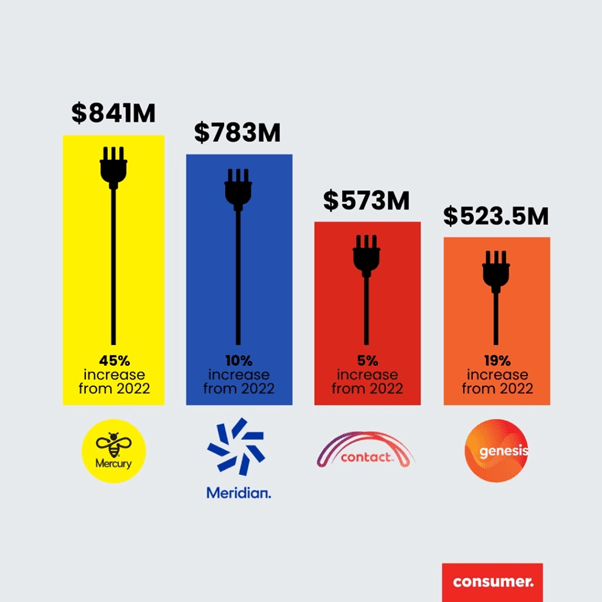
Big four power companies earning $7 million every day

The ‘big four’ power companies made a combined net profit after tax of $520m in the last financial year
Ella Bates-Hermans/Stuff
The “big four” power companies are earning more than $7 million every day while some households struggle to heat their homes, according to Consumer NZ.
According to their financial reports, Meridian, Contact, Genesis and Mercury had combined earnings of $2.7 billion over the last year – about $7.4m a day.
But while the consumer watchdog says the numbers are a bad look for the generation and retail power companies (gentailers), the industry says it is ploughing earnings back into developments to help New Zealand transition to a carbon-zero economy.
Consumer NZ chief executive Jon Duffy said 60% of New Zealanders were concerned about the cost of energy and “the optics of huge profits at the height of a cost of living crisis aren’t great.”
“We estimate 40,000 households have gone without power at some point in the past year because they couldn’t afford to pay,” Duffy said.
The Government is fast-tracking the consent process for new wind and solar energy projects, with Prime Minister Chris Hipkins saying it could eventually lead to cheaper power prices
“New Zealanders have the ability to save on their power by shopping around, but that only goes so far. More work needs to be done to ensure consumers can have confidence our electricity sector is working to their benefit.
“We acknowledge that profits are a healthy and normal part of business, but there’s a question around what is excessive.”
Energy Retailers Association chief executive Bridget Abernethy said its members were playing a key role in New Zealand’s transition to a zero-carbon economy and investing heavily in projects to make that happen.
Financial records show the “big four” companies, which provide power to about 85% of the market, made a combined net profit after tax of $520m in the 12 months to June 30. That was down 66% on combined profit of more than $1.5b the year before.
“We’re ploughing earnings back into developments. Market analysts estimate we’ll invest around $4 billion in renewable generation in the next five or six years,” Abernethy said.
“ERANZ members are very conscious of the cost pressures Kiwis are facing and have programmes in place to help those most in need. It’s also worth noting that increases in household power bills have been well below the rate of inflation over the past five years.”
Recent Consumer NZ research showed 19% of households had trouble paying their monthly power bill in the past 12 months, while 12% reported being cold because they had to cut back on heating due to cost.
The survey also found 6% of households had to switch to a more expensive prepay plan because they had had trouble paying their electricity bills.
Those on prepay power plans paid about 15% more for their power, and were automatically disconnected if they ran out of credit, Duffy said.
“When faced with a choice between paying more for power, or going without power, in reality there is no choice.
“We’re ploughing earnings back into developments. Market analysts estimate we’ll invest around $4 billion in renewable generation in the next five or six years,” Abernethy said.
“ERANZ members are very conscious of the cost pressures Kiwis are facing and have programmes in place to help those most in need. It’s also worth noting that increases in household power bills have been well below the rate of inflation over the past five years.”
Recent Consumer NZ research showed 19% of households had trouble paying their monthly power bill in the past 12 months, while 12% reported being cold because they had to cut back on heating due to cost.
The survey also found 6% of households had to switch to a more expensive prepay plan because they had had trouble paying their electricity bills.
Those on prepay power plans paid about 15% more for their power, and were automatically disconnected if they ran out of credit, Duffy said.
“When faced with a choice between paying more for power, or going without power, in reality there is no choice.
However, Abernethy said prepay services gave customers flexibility to manage their income and some liked the real-time visibility of their energy use and payments.
“Anyone struggling with their power bill is likely juggling other debts as well, so it’s a way of helping customers manage debt overall, not just their electricity.”
Government agencies and budgeting services recommend prepay connections to vulnerable customers where it was appropriate and prepay could be a valuable tool to help some households manage overall cashflow and expenses, she said.
“Disconnection is always an absolute last resort for our members after exhausting other options. We encourage people struggling to pay for their power to talk to their provider – our members are committed to working with customers to find solutions to help them stay connected.”
Abernethy said retailers recognised they had a responsibility to support vulnerable customers and ensure a customer’s debt level didn’t spiral out of control, and a robust system was in place for working with customers having difficulty.”
Power Prices
It has been a while since the last campaign update to our coalition members! We’d love to share some of what we’ve been working on, and our plan for the next couple of months.
- We have been calling for all tertiary students to receive half price fares through Community Connect (which currently applies to under-25s, Community Services Card holders, and Total Mobility). Half of students are 25 and over, missing out on more affordable public transport.
- Students Association Presidents around the country signed an open letter on this, which you can read here.
- Read our press release here.
- We recently received estimated costings by OIA request which reveal that free public transport for all tertiary students is only $28m over 4 years (compared to $674m for under-25s and $221m for CSC holders).
- We plan to focus on including students in Community Connect as an achievable win post-elections.
- We have responded to issues that have arisen with the new Total Mobility discounts. Contrary to earlier communications and understandings, half-price fares for Total Mobility is only applying to taxis and not other public transport. This is a real disappointment which we are hoping will be corrected by the Government.
- Some of our amazing Auckland volunteers ran a stall at a UN Youth Conference for secondary students. Many postcards were written and sent off to the Minister for Transport, David Parker.
- We have been meeting with MPs and candidates to discuss Free Fares. We think that it’s really important for public transport affordability to be front-of-mind for all political parties this election. If you are meeting with any MPs/candidates or attending candidate forums, please ask candidates if they support Free Fares.
Leading up to the election we want to use the opportunity of candidate forums and debates to platform public transport equity as an issue which Aotearoa cares about. Please let us know if you are involved with any candidate events and are able to include a question about Free Fares. We also will run an online training in September, to prepare supporters to raise questions at candidate events. Keep an eye out for more information on this.
Let us know what your organisation is planning in the lead-up to the election. Is there anything we can get involved with, and any ways that you can include Free Fares in what you’re already doing? We’re always keen for collaboration!
Protect families struggling with power prices
Kia ora friends,
Thank you for signing “Protect families struggling with power prices”.
We’re gathering stories to highlight the urgent need for change.
Are you on prepay power? Or ever paid a disconnection fee? Share your story here. We’ll use anonymous stories in the media, like in this article in the Christchurch Press. We’ll also pass stories on to decision-makers so they are informed of realities on the ground.
We also need your help to share this petition with friends and family. The more people who sign, the more pressure we can build on the Electricity Authority to change the rules for retailers.
Posting something on facebook or twitter will only take a second, but will mean that hundreds of people see the petition and can join our movement.
Thanks for your support, and for considering sharing your story.
Kate and the Everyone Connected team
everyoneconnectednz.com
PS – If you’re struggling with power bills right now, here’s some advice from Citizens Advice Bureau.
‘Free’ prescriptions will have long-term costs – pharmacists

Discount pharmacies like the Chemist Warehouse and Countdown supermarket stores do not ask for the usual $5 prescription charges. Photo: RNZ /Dom Thomas
The head of the Pharmacy Guild says community pharmacies are shutting down thanks to the influx of Australian-owned discount chains.
Chief executive Andrew Gaudin warns in the long-term, this will reduce access to essential healthcare services – particularly for people outside the main centers.
Discount pharmacies like the Chemist Warehouse and Countdown supermarket stores do not ask for the usual $5 prescription charges.
“They’re using their commercial buying power and clout and running a loss-leader model, Gaudin told RNZ’s Nine to Noon
“They’re absorbing the government’s $5 prescription charge. Effectively they’re manipulating government policy to buy market share, and drive and squeeze out the smaller, independent [owner-operator] pharmacies.”
Prescription co-payments were first introduced in the 1980s, and by the 2000s the cost had risen to double-digits. The then Labour-led government reduced the charge to $3, which rose to $5 in 2013 under the following National-led government.
In recent years big-box pharmaceutical retailers have started absorbing that cost, essentially making prescriptions free and giving them an advantage over smaller, locally owned outlets.
Gaudin said for a typical pharmacy to absorb the cost would mean taking a $120,000 hit. Unable to do so, 70 community pharmacies have closed in the last four years, according to the Pharmacy Guild. Last year alone saw 30 shut their doors.
In Auckland, Seema Rambisheswar permanently closed her Life Pharmacy store in Glenfield Mall just over a week ago, after working there for 22 years and owning it for 14.
“It’s quite sad the time has come for me to close,” she told Nine to Noon.
The writing was on the wall in 2020, when right after Covid-19 hit, a Chemist Warehouse opened in the same mall. Her landlord, assuming she’d struggle with rent, offered her a smaller venue.
“I said no because if I did that, I’d have to refit a store and defit my existing store… that would just not have been viable.”
She said big stores that don’t charge the co-payment have led customers into wrongly believing that pharmacies who do charge are pocketing the money.
“They have to realise it doesn’t. We collect it. We’re tax collectors. We collect it on behalf of the government and then we have to pay it back to the government. It doesn’t stay in our tills.
“Now that I’m closing, people are [saying], ‘We will pay you, please don’t close.’ But it’s too late. I’m at a point of no return…
“They’re using the co-payment as a loss-leader. People are not looking at the bigger picture… they need to wake up, because long-term there will be problems.”
RNZ
Rambisheswar and Gaudin both say community pharmacies offer a range of services the discounters don’t – such as vaccinations, ongoing care and even simple things like advice on the medicines they’re dispensing.
Rambisheswar said despite the cost, she sometimes doesn’t charge the fee – particularly if the patient needs multiple medicines, each one costing $5.
“We don’t want in the long-run for people like that to be hospitalised, then there’s a burden on the hospital system and the cost on the government would be higher… We care about our people. We care about our community and we don’t want them to be deprived of healthcare.”
The Pharmacy Guild is currently in a legal battle with Te Whatu Ora, over former district health boards giving operational licences to two Countdown pharmacies that offer zero-free prescriptions.
The Wainuiomata Countdown was initially denied a licence, a decision overturned by a DHB official who said having free options for patients would increase equity of access to medicines. A lawyer for Te Whatu Ora said the guild’s members were more concerned about having retail competition, not public health.
Rambisheswar said either the co-payment needs to either be abolished or made compulsory so there’s an even playing field.
“We care about our people. We care about our community and we don’t want them to be deprived of healthcare.”
Removing prescription charge has dramatic impact on odds of hospitalisation – study
A New Zealand-based study published in January found “prescription co-payments are likely to increase overall healthcare costs”, with the small fee discouraging people from collecting their medicines, and ending up needing hospital care as a result. The authors “strongly recommend that the $5 prescription co-payments be removed for those with high health needs and low incomes, or be scrapped entirely”.
“[Some people] go without their medicines, and as a result their health problems get worse, so they need hospital care. This is bad for them, their whānau, and the health system,” research lead Pauline Norris said.
The study found for every 100 people who received free prescriptions, 33 were admitted to hospital and stayed for 208 days.
For every 100 people who still had to pay the $5 charge, 41 were admitted to hospital and stayed for 326 days.
“New Zealander’s are exempted from the $5 charge after 20 items in a year, so revenue is, at most, $100 per person… The cost of one day of hospital care in New Zealand has been estimated at $1000 to over $1500.”
Removing the charge reduced the number of admissions for mental health problems, the number of admissions for chronic obstructive pulmonary disease (COPD), and the length of stay for COPD admissions, the study found.
A recent New Zealand health survey found 3.3 percent of adults reported going without a medicine because of costs. This was more common for Māori and Pacific peoples, and those living in areas of high deprivation.
Gaudin said removing the co-payment altogether would not only help smaller pharmacies with a community focus stay in business, but help with the government’s stated goal of easing cost of living pressures.
“Not only can we improve health outcomes, have a better service offering and have a more sustainable network of pharmacies, we could also remove a cost of living pressure which would fit neatly with the government’s top priority of dealing to that.”
Petition at Parliament
In this video we start at the doorsteps of Parliament.
Dr Nikki Turner and United Community Action Network are delivering a petition to Riccardo Menendez March
Debbie Leyland from UCAN started with an introduction to the speakers, next was Nikki Turner and then Riccardo.
Please click the image below to view video

Notes from Newtown & Strathmore Community and Health Network Meetings
August / September 2022
Two meetings were held in August and September with representatives from community health groups, local church groups, health providers, community centres, activists in the Newtown and Strathmore areas and representatives from Te Whatu Ora Capital Coast to talk about the health reforms, locality plans and for networking of health and community agencies working in the area.
Below is a summary of the presentations, discussion, issues, questions and ideas:
Summary of discussion at meeting 18/08/2022:
The Health and Disability Reforms: Te Whatu Ora Capital Coast
* Te Whatu Ora, at a district level, is now required to hear what is important and what the need is to feed this into local plans
* The reforms are not about changing services for people who it already works for. They are about re-directing services to reach and making a difference to people with whom we haven’t previously been able to reach/engage
* Equity – starting with people that need health services the most e.g. Māori, Pacific, Disabled, Homeless communities
* Commitment to delivering pae ora/ healthy futures
* Previous engagement across Newtown/Strathmore communities has occurred at an informal level. Previous engagement work that has been done and is being used to inform future conversations
* Localities will have “locality plans” which will be informed by the people, communities and providers who live there.
o Embedding Te Tiriti o Waitangi into the plans through Mana Whenua leadership
o Must be agreed by the Iwi Māori Partnership Board – Atiawa Toa Hauora Board, Te Aka Whaiora and Te Whatu ora
o Likely will be aspirational and visionary
o Ensuring we capture voices/representation from our priority populations (Māori, Pacific, Disability)
* In Porirua the formal establishment of the prototype locality has been led by Ngāti Toa and Te Whatu Ora are supporting them.
* We are waiting to hear what establishment leadership will look like and how Wellington might be consolidated (e.g. 1 or 2 localities) and will become more clear over time.
* Te Whatu Ora have a legislative requirement to write the locality plans:
o Representative of the communities
o Re-align and re-invest in service provision based on needs of the community
o Alignment of health services around Pae Ora model – Whānau ora, Mauri ora and Wai ora.
o Supporting providers to network, communicate and connect
o Understanding the current mechanisms and existing ways providers and communities connect and building on this.
2
Community Discussion/ Questions
* Q: Are communities represented on boards?
o A: Key thing is for the board to get assurance that community voice is feeding into the plans
* Q: How will elders be prioritised?
* Q: How will Te Whatu Ora manage communication between boards and communities across the system?
o i.e. if a communities needs/suggestions are not reflected in local plans (as a priority action) how will this get feedback to the communities, even if it is a longer term aspiration.
* Include longer term feedback mechanisms in comms plan. For example, when initiatives/ideas/services aren’t included in immediate plans, feedback mechanisms for longer term aspirations should be thought of and planned for.
* Community groups bridge the gap between governmental agencies from different sectors. We need to work across the system if we want to embed a holistic hauora/ te whare tapa wha model effectively. This is the key to how people want to experience their health
* Spiritual forums and leaders should be considered to reach more people
* Community centres such as Strathmore Park CC are not a health or social provider. How might the roll out of localities include CC i.e. will health providers be commissioned to come to Strathmore CC rather than being commissioned to provide the service themselves?
* Relationships and responsibilities need to be clear to communities.
* Be honest about the limitations and be equal with the community. We are all one and we should behave in a way where relationships are at the front. Job titles and contracts don’t dictate who you are to a community
* Providers have dominance over the voice of the communities that they represent and are speaking on behalf of communities. Communities want to take back their voice.
Meeting notes – 8/09/2022
Discussion/ Questions
* How is Te Whatu ora ensuring the change happening is sustainable?
* How will we ensure the voice of people on the frontline are contributing to the development of plans?
* What does the annual planning cycle looking like?
* What are the timescales for change and implementation?
* What role will PHOs play in the new structure?
* What does a model look like for Wellington?
* How do we ensure the “why” in a locality plan? How will needs and aspirations of communities be reflected in the commissioning cycle?
* How will commissioners balance the priorities/demands of improving national outcomes, with locality directed need when the two do not align? In terms of investment, new initiatives.
3
* How could funding change for providers? Considerations should be given to
#1. Priority populations that provider serves,
#2. How the gentrification of urban areas affects the funding formula and
#3. That changes should be agreed together
Aspirations/Expectations
* Flexible service delivery – agreeing the “what” and allowing flexibility on “how” that is achieved. Communities know what is needed, are already well-networked and are able to reach whanau and people who do not typically engage with health services or “community consultation”
* For community consultation to be joined up across sectors – recognising that wellbeing and health is much wider than the services health offers.
o How can we work together?
o Connecting and relationship building around people, whanau, and communities.
* To enable the resources and skills to solve problems at the level which they arise
Principles:
* Shared power, shared accountability, shared decision making
* Personal information is sacred
* Invested community = meaningful change
* Embedding relationships into service delivery through trusted services
Ideas/ Actions:
* Develop a community health profile
* Developing a locality pack for the Newtown/Strathmore community
* Develop a strawman community proposal on a page/ articulating the needs in the Newtown/Strathmore areas, agreed on by the community
o Develop a working overarching vision for the community to test and adjust – aspirational collective vision
o Outcomes to collectively achieve
o Priority areas (statements of intent)
o History of the area – i.e. service and health provision history – what is the story for Newtown/Strathmore?
* What activities/services have been stopped that should be started again?
What exists now that doesn’t work for people and whanau?
Where do we have unnecessary duplication?
Where do we have gaps in service delivery that impact on the continuum of care?
o What could we measure to know whether we are making a difference? What statistics or outcome measures?
o Who are our key partners?
o How will the community be informed and engaged?
o Do we have any opportunities for quick wins?
* Developing the local narrative
o Overlaid with health and social data/ Gentrification over time
– Form an initial point of contact group with 4-5 of the leaders/ people present at meeting.
Notes written by Chontelle King and Eileen Brown
 UCAN - United Community Action Network Aotearoa NZ